When we speak of Sanskrit kāvya, the mind reflexively turns to the mahākavi-s—Kālidāsa, Bhāravi, Māgha, Bhāravi, Bāṇabhaṭṭa—whose names form the canonical constellation of classical Indian literary achievement. Yet woven through this predominantly male-preserved tradition runs a quieter, often overlooked but very influential thread of the voices of women poets whose technical mastery and creative vision equaled, and at times surpassed, their celebrated male contemporaries.
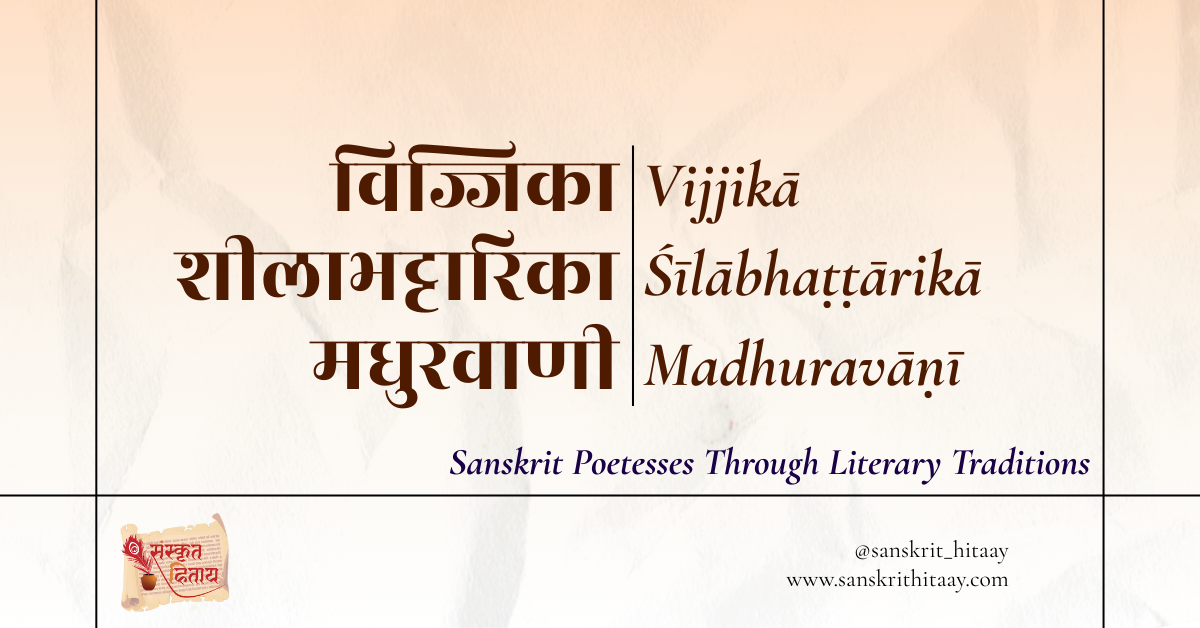
Following our examination of Bhāvakadevī‘s work, three additional poetesses demand our attention—not as curiosities or exceptions to a male norm, but as accomplished practitioners who commanded the full technical apparatus of Sanskrit poetics while bringing distinctive perspectives to perennial literary themes.
Vijjā/Vijjikā: The Self-Proclaimed Incarnation of the Goddess of Speech
Among the women poets documented in Sanskrit literary sources, Vijjā (or Vidyā in Sanskritized form) occupies a singular position. Her self-confidence bordered on audacity—she explicitly styled herself as an embodiment of Sarasvatī, the goddess of learning and eloquence. This was not merely rhetorical flourish or conventional humility-disguised-as-praise; Vijjā’s claim reflected genuine mastery over the most demanding technical aspects of Sanskrit poetics. Vijjikā was perhaps the greatest, most well-known and most versatile poetess who has remained in the forefront of Sanskrit poetess.
Her reputation rested particularly on her facility with dīrgha-samāsa-s (extended compounds). The ability to craft such compounds with clarity while maintaining aesthetic effect distinguished accomplished poets from mere versifiers. Her most celebrated verse directly challenges Daṇḍin’s conventional description of Sarasvatī in the Kāvyādarśa:
नीलोत्पलदलश्यामां विज्जकां मामजानता ।
वृथैव दण्डिना प्रोक्तं सर्वशुक्ला सरस्वती ॥
“Not knowing me, Vijjaka, dark like the petal of a blue lotus, Daṇḍin has vainly described Sarasvatī as entirely white.”
The verse operates on multiple registers simultaneously. On the surface level, it contests the iconographic convention of depicting Sarasvatī as śukla (white/bright), asserting instead a śyāma (dark) manifestation embodied by the poetess herself. More significantly, the verse performs what it describes. By challenging Daṇḍin—arguably the most influential theorist of poetic style (mārga) in the classical tradition—Vijjā positions herself not as a derivative follower of established authorities but as an independent voice capable of disputing even canonical formulations. The use of vṛthā (vainly, uselessly) is particularly bold; she does not merely offer an alternative reading but suggests that Daṇḍin’s description is fundamentally inadequate because it fails to account for her existence as Sarasvatī’s avatāra.
Read more about Vijjikā here, here and here (Kaumudī Mahotsavam)।
Śīlā Bhaṭṭārikā: Psychological Acuity in the Pāñcālī Mode
Where Vijjā commanded attention through stylistic audacity, Śīlā Bhaṭṭārikā achieved recognition for subtler virtues: psychological penetration and musical fluency. The testimony to her stature comes from the highest authorities—Rājaśekhara (quoted in Jalhaṇa’s Sūktamuktāvalī) alongside Rucyaka in his Alaṅkāra-Sarvasva. In the competitive and hierarchical world of Sanskrit literary culture, such recognition from major kavi-s indicates that Śīlā’s work was considered essential to any comprehensive understanding of the poetic tradition.
Her style exemplified the Pāñcālī rīti, one of the regional stylistic paths (mārga-s) identified in Sanskrit poetics. The Pāñcālī mode emphasized melodic flow and relative syntactic transparency—in contrast to the more ornate and compound-heavy Gauḍīya or Vaidarbhī styles.
Śīlā’s particular genius lay in articulating the phenomenology of vipralambha (love-in-separation), perhaps the most explored theme in Sanskrit poetics yet one that perpetually demanded fresh treatment. Her most celebrated verse exemplifies this capacity:
यः कौमारहरः स एव हि वरस्ता चैत्रक्षपा- स्ते चोन्मीलितमालतीसुरभयः प्रौढाः कदम्बानिलाः ।
सा चैवाऽस्मि तथापि चौर्यसुरतव्यापारलीलाविधौ रेवारोधसि वेतसीतरुतले चेतः समुत्कण्ठते॥
He who was my first love, that very same lover (is present now); those very same nights in the month of Caitra (have arrived); the same old wind, fragrant with the smell of the full-blown mālatī flower, is blowing through the kadamba tree; I am also the same old self. Still my heart is longing for stolen amorous sports under the cane-creepers on the banks of the river Revā.
विरहविषमो वामः कामः करोति तनुं तनुं दिवसगणनादक्षश्चायं व्यपेतघृणो यमः।
त्वमपि वशगो मानव्याधेर्विचिन्तय नाथ हे किसलयमृदुर्जीवदेवं कथं प्रमदाजनः॥
Let the cruel love, agonising through separation, wear away my body. Yama (the god of death) is incapable of counting the days and has lost all mercy (for me). O my lord! you too have fallen a prey to indignation. Under these circumstances, how can a woman, tender like a bud, live?
प्रियाविरहितस्यास्य हृदि चिन्ता समागता। इति मत्वा गता निद्रा के कृतघ्नमुपासते॥
Thought has arisen in the heart of one separated from his beloved,-seeing this, sleep has deserted him. Who would adore a faithless one?
दूति त्वं तरुणी युवा स चपलः श्यामास्तमोभिर्दिशः सन्देशः स रहस्य एव विजने सङ्केतकावासकः।
भूयो भूय इमे वसन्तमरुतश्चेतो नयन्त्यन्यतो गच्छ क्षिप्रसमागमाय निपुणं रक्षन्तु ते देवताः॥
O messenger-maiden! you are a young woman, he (too) is a fickle young man. Darkness reigns everywhere. The message (you are carrying) is full of mystery. The place appointed for meeting is the forest. This spring-breeze is again and again turning one’s thoughts to other directions. O clever one! go for arranging this auspicious meeting (between us). May the gods protect you!
श्वासः किं त्वरिता गता पुलकिता कस्मात्प्रसादः कृतः स्रस्ता वेण्यपि पादयोर्निपतनान्नीवी च गमादागमात्।
स्वेदार्द्रं मुखमातपेन गमितं क्षामा किमित्युक्तिभिर् दूति म्लानसरोरुहाकृतिधरस्यौष्ठस्य किं वक्ष्यसि॥
(Ques.) Why are you breathing deeply? (Ans.) I have come hurriedly. (Ques.) Why are you pleased? (Ans.) I have been favoured. (Ques.) Why have your locks too become loose? (Ans.) Because I fell down on his feet. (Ques.) What about your waist-garment? (Ans.) (It has got loose) because of my going and coming back. (Ques.) Your face is bedewed with perspiration. (Ans.) It has been scorched by the sun. (Ques.) What is the use, O messenger-maiden, of prattling in vain? Your lips have become like a withered lotus. What will you say about that?
इदमनुचितमक्रमश्च पुंसां यदिह जरास्वपि मान्मथा विकाराः ।
इदमपि न कृतं नितम्बिनीनां स्तनपतनावधि जीवितं रतं वा ॥
the first half of verse is composed by Śīlā Bhaṭṭārikā while subsequent by Bhojarāja
(The poetess says:) It is improper as well as confusing that men should be subject to amorous sentiments even during their old age. (The King retorts:) That, too, is equally improper that women, so long as they are capable, should indulge in amorous passions even at the cost of their lives.
A point worth noting here is that these verse does not traffic in the spectacular or hyperbolic. Its effectiveness derives from restraint, from the gap between what is stated and what is implied. The dhvani (suggestion)—the premier category in later Sanskrit poetics—operates through this very reticence.
Madhuravāṇī: Scholarly Virtuosity in the Nāyaka Courts
Moving forward to the seventeenth century CE, particularly in South India where the Nāyaka dynasties maintained vigorous traditions of learning, Madhuravāṇī flourished in precisely this environment—the court of King Raghunātha of Tanjore (r. 1614–1634 CE), one of the most significant patrons of Sanskrit and Telugu literature in his era. We do not know whether this poetess is the same Madhuravarṇī whose very is compiled in Subhāṣita-Hārāvalī
As it might seem, the name Madhurāvaṇī is not a real name but only a descriptive title depicting the melodious voice she possessed. We do not receive any background about her life but we through the information furnished through her works, it is evident that she belonged to a learned family. She claims her proficiency over music and other similar arts which would have enabled her secure the patronage of the king.
At Raghunātha’s request, she undertook to render his Telugu epic, the Āndhra-Rāmāyaṇa, into Sanskrit—a project that resulted in the Rāmāyaṇa-sāra-kāvya, spanning fourteen sarga-s (cantos) and comprising approximately 1,500 śloka-s. This was not mere translation in the modern sense but rather bhāṣāntara (transformation across languages), a recognized literary practice that required independent creative authority. Madhuravāṇī had to reconceive the Āndhra-Rāmāyaṇa‘s narrative and poetic effects within Sanskrit’s formal constraints while preserving what made the Telugu original compelling.
That she completed this massive undertaking while maintaining the standards of sāra-kāvya (essence-poetry)—a designation suggesting concentrated literary merit—showcasing her complete command over Sanskrit’s technical apparatus. The work required mastery of chando-viciti (prosodic variation), alaṅkāra-prayoga (deployment of rhetorical figures), rasa-niṣpatti (emotional realization), and all the other components that distinguished genuine kāvya from versified narrative. The complete work, however, is not available today.
Conclusion
These three figures—Vijjā, Śīlā Bhaṭṭārikā, and Madhuravāṇī—represent not isolated exceptions but exemplars of a sustained, if partially documented, tradition of women’s participation in Sanskrit literary culture. Their works survive not through special pleading or antiquarian curiosity but because they met the technical and aesthetic standards that determined what deserved preservation and transmission.
The diversity of their achievements matters as much as the fact of their existence. Vijjā’s bold stylistic assertions, Śīlā’s psychological subtlety, Madhuravāṇī’s scholarly monumentalism—each represents a different possibility within the vast expanse of Sanskrit kāvya. They were not confined to “women’s themes” or relegated to minor genres. They composed in the highest registers, handled the most demanding technical challenges, and addressed the tradition’s central preoccupations on equal terms.
Bibliography
Choudhuri, Jatindra Bimal, ed. Sanskrit Poetesses (Part A). With English Introduction and Translation by Roma Chaudhuri. The Contribution of Women to Sanskrit Literature, Vol. 1.
Choudhuri, Jatindra Bimal, ed. Sanskrit Poetesses (Part B). With English Introduction and Translation by Roma Chaudhuri. The Contribution of Women to Sanskrit Literature, Vol. 2.
संस्कृत वाङ्मय का बृहद् इतिहास भाग ५ गद्य